Rules of Hold'em: How to Play Texas Hold'em Poker Step by Step

Texas Hold'em is the most popular poker game in the world, and the good news is that the rules of Hold'em fit on a single page. Two private cards, five shared cards, four betting rounds and one goal: make the best five-card hand or get everyone else to fold. In this guide we explain the rules of Hold'em step by step, from the dealer button and the blinds to the flop, turn, river and showdown, plus the poker hand rankings, your betting options and the house rules that keep a home game running smoothly. All you need to get started is a deck of cards and a poker set with chips.
Short answer: in Texas Hold'em every player gets two face-down hole cards. Two players post forced bets, the small blind and the big blind. Then there are four betting rounds: preflop, the flop (three community cards), the turn (a fourth card) and the river (a fifth card). In each round you can check, bet, call, raise or fold. If more than one player is left after the river, the best five-card hand made from your two cards and the five community cards wins the pot. To play at home you need a poker set with chips, cards and a dealer button, such as the Poker Set Las Vegas Poker Club Tournament 500, which is recommended for 2 to 9 players.
What you need to play Texas Hold'em at home
Hold'em is played with 2 to 10 players at one table. You need:
- Poker chips. Chips make betting fast and clear. Each colour represents a value. Our complete sets, such as the Poker Set Monte Carlo Cash Game 500, come with 500 clay composite chips (40 mm, 14 g) in an aluminium case and are recommended for 2 to 9 players.
- A standard 52-card deck. No jokers. Plastic cards last much longer than paper ones: our Poker Cards Poker Merchant Plastic Black 2 Index are 100% plastic, waterproof and resistant to bending.
- A dealer button. It shows who is on the button this hand, and therefore who posts the blinds. Our sets include one; a dedicated Dealer Button Hold'em & Omaha (50 mm, 26 g) is a nice upgrade.
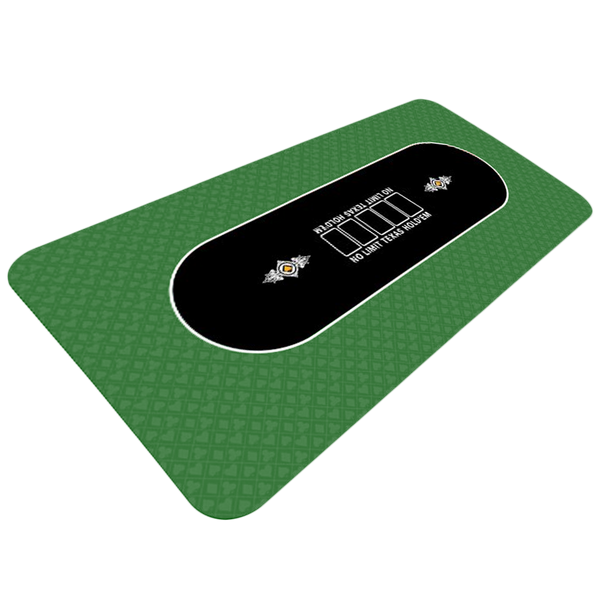
- A playing surface. A poker mat makes cards easy to pick up and keeps chips from sliding. See our guide to the best poker mat.

The rules of Hold'em: dealer button, blinds and hole cards
Before the cards come out, three positions decide the order of play:
- The button (dealer). The player with the dealer button acts last after the flop, which is the best seat at the table. The button moves one seat clockwise after every hand, so everyone gets a turn. In a home game the player on the button often deals, but anyone can deal as long as the button marks the position.
- The small blind. The player directly to the left of the button posts a forced bet, usually half the big blind.
- The big blind. The next player to the left posts the full forced bet. With blinds of 1/2, the small blind puts in 1 chip value and the big blind 2.
The blinds make sure there is always something to play for. After the blinds are posted, the dealer gives every player two cards face down, one at a time, starting with the small blind. These are your hole cards: only you see them.
Heads-up exception: when only two players are left, the button posts the small blind and acts first before the flop, while the other player posts the big blind. After the flop the button acts last.

How a hand of Texas Hold'em works, step by step
Every hand has up to four betting rounds. Before the flop, the turn and the river, the dealer "burns" the top card face down, so nobody can gain an advantage from a marked or flashed card.
| Round | Cards dealt | Who acts first |
|---|---|---|
| Preflop | 2 hole cards per player | The player to the left of the big blind ("under the gun") |
| Flop | 3 community cards face up | The first active player to the left of the button |
| Turn | 1 community card (4 in total) | The first active player to the left of the button |
| River | 1 community card (5 in total) | The first active player to the left of the button |
| Showdown | No new cards | The last player who bet or raised shows first |
1. Preflop
Looking only at your two hole cards, you decide whether to play. Action starts with the player to the left of the big blind and moves clockwise. To stay in, you must at least call the big blind. The big blind acts last preflop and may check if nobody raised.
2. The flop
The dealer places three community cards face up in the middle. Everyone can use these cards. A new betting round starts with the first player still in the hand to the left of the button.
3. The turn
A fourth community card is dealt, followed by another betting round. In fixed-limit games the bet size usually doubles from here.
4. The river
The fifth and final community card is dealt, followed by the last betting round.
5. The showdown
If two or more players are left after the river, they show their cards. Each player makes the best possible five-card hand from any combination of their two hole cards and the five community cards: two, one or even none of your own cards. If the best hand is on the board, you "play the board" and the pot is split between everyone left in the hand. If everyone folds before the showdown, the last player standing wins the pot without showing their cards.
Your betting options: check, bet, call, raise or fold
| Action | What it means | When you can do it |
|---|---|---|
| Check | Pass the action without betting | Only when nobody has bet in this round |
| Bet | Put the first chips into the pot this round | When nobody has bet yet |
| Call | Match the current bet | When someone has bet |
| Raise | Increase the current bet | When someone has bet |
| Fold | Give up your cards and your claim to the pot | Whenever it is your turn |
| All-in | Bet all the chips you have in front of you | Whenever it is your turn |
A betting round ends when every remaining player has put in the same amount or folded. A player who is all-in cannot be forced out of the hand: if others keep betting, those extra chips go into a side pot that the all-in player cannot win. An All In Button Red Spade makes it clear to everyone at the table that a player is all-in.
No-limit, pot-limit or fixed-limit Hold'em
- No-limit: you can bet any amount up to all your chips at any time. A raise must be at least as large as the previous bet or raise in that round. This is the version you see on TV and in most home games.
- Pot-limit: the maximum bet or raise is the size of the pot.
- Fixed-limit: bets and raises are a fixed amount, the small bet preflop and on the flop and the big bet (usually double) on the turn and river, with a cap on the number of raises per round.
Poker hand rankings in Texas Hold'em
From strongest to weakest. Suits have no rank: two equal hands split the pot.
| Rank | Hand | Example |
|---|---|---|
| 1 | Royal flush | A-K-Q-J-10, all the same suit |
| 2 | Straight flush | Five cards in a row, same suit |
| 3 | Four of a kind | Four cards of the same rank |
| 4 | Full house | Three of a kind plus a pair |
| 5 | Flush | Five cards of the same suit |
| 6 | Straight | Five cards in a row, mixed suits |
| 7 | Three of a kind | Three cards of the same rank |
| 8 | Two pair | Two different pairs |
| 9 | One pair | Two cards of the same rank |
| 10 | High card | None of the above; highest card counts |
When two players have the same type of hand, the higher cards win. With the same pair, the highest side card (the "kicker") decides. An ace can be high (10-J-Q-K-A) or low (A-2-3-4-5) in a straight, but a straight cannot wrap around (Q-K-A-2-3 is not a straight).

Cash game or tournament: chips and blinds
The rules of Hold'em are the same in both formats, but the chips work differently:
- Cash game: chips represent real stakes, blinds stay the same all night and players can buy in again or leave at any time. A set with clearly marked values, such as the cash game poker sets, makes counting easy.
- Tournament: everyone starts with the same stack of chips, the blinds go up at fixed intervals and you play until one player has all the chips. Choose one of our tournament poker sets.
How many chips does each player get, and which colours are worth what? Our guide to poker chip values explains colour values, starting stacks and chip distribution for cash games and tournaments.
House rules for a smooth home game
- Agree on the blinds and buy-in before you start, and in tournaments on how often the blinds go up.
- Act in turn. Acting before it is your turn gives information away and is not fair to the players before you.
- Say your action out loud. "Call" or "raise to six" avoids discussion. A single chip pushed forward without a word counts as a call in most home games.
- No string bets. Put your full raise in at once, not in several trips to your stack.
- Cards speak. At the showdown the cards decide, not what a player says they have.
- Protect the deck. A Cut Card Poker Merchant keeps the bottom card of the deck hidden while dealing.
Complete your setup
Ready to deal your first hand? These products help you play by the rules:
- Poker Set Las Vegas Poker Club Tournament 500: one of the most popular sets in our collection, with 500 clay composite chips, two decks of cards and a dealer button. Compare more options in our guide to the best poker sets.
- Poker Mat Texas Green 180x90: turns your dining table into a Hold'em table. See all poker mats.
- Dealer Button Hold'em & Omaha: keeps the blinds and the deal moving in the right order.
- All In Button Red Spade: shows at a glance who has put all their chips in.
- Extra cards: keep a spare deck at the table. Read our guide to the best deck of playing cards for poker or browse all poker cards.

Playing every week? The Foldable Poker Table Las Vegas (213 × 106 cm, 6 to 9 players plus a dealer) has an armrest, a built-in dealer chip tray and folding legs. See all poker tables.
Frequently asked questions
How many cards does each player get in Texas Hold'em?
Two hole cards each. Together with the five community cards, every player chooses the best five-card hand from seven cards.
Do you have to use both hole cards?
No. You can use two, one or none of your hole cards. If the five community cards are your best hand, you play the board.
Who goes first in Texas Hold'em?
Before the flop, the player to the left of the big blind acts first. After the flop, the first active player to the left of the button acts first.
How many players can play Texas Hold'em?
From 2 to 10 players at one table. Our complete poker sets are recommended for 2 to 9 players.
What happens if two players have the same hand?
The pot is split. Suits never decide who wins in Texas Hold'em.
Our advice: learn the rules of Hold'em by playing
The rules of Hold'em are learned in one evening: post the blinds, deal two cards, play four betting rounds and compare the best five-card hands. Start with low blinds, keep the hand rankings table nearby and move the dealer button after every hand. Want to know how many chips everyone should start with? Read our guide to poker chip values or our buying guide what poker chip set to buy.
Ready to play? Find chips, cards and a dealer button in one case in our poker set collection.
Find the right poker chip set
Compare sets by chip count, material and budget.